← Map of all journeys parcours-anglais-lycee.netlify.app/premiere/is-it-fair-ruby-bridges/

The big question

What makes a school system fair, and can a court decision change what people believe?

Why this journey?

In 1960, a six-year-old girl needed four federal marshals to walk into her school. In this journey, you discover Ruby Bridges, the Supreme Court decisions that opened and closed school doors, and the question that is still debated today: how do we make school fair for everyone? You never talk about your own school or family situation: you study cases and invented situations. At the end, the class holds a mock trial.

LevelPremière (general)
TargetCEFR B1 → B2
Sessions6 sessions + a game + a final task
Final taskMock trial (B1–B2): each student argues once (1 minute), then writes a 120-word verdict.

Bridges This journey is part of a path: each journey answers and builds on others.

⟵ Builds on…

Leads to… ⟶

Threads in this journey: FairnessPowerVoice

1

Fair or unfair?

Decide what makes a school system fair.

What you do

  1. Your teacher gives six invented situations (a school only for one neighbourhood, a lottery, an entrance exam…).
  2. Rank them from most fair to least fair, in groups.
  3. Compare the rankings and agree on three criteria for a fair system.

Sentence starters

  • It is fair when…
  • It is unfair when…
  • A fair school system should…

Speak up

Each group defends its top situation in 30 seconds.

Learn how to learn · Quick Recall

Before you open your notes, write 3 things you remember from last time. Then check. Testing yourself works better than reading again.
2

Six years old, four marshals

Discover Ruby Bridges’ first day.

Documents and facts

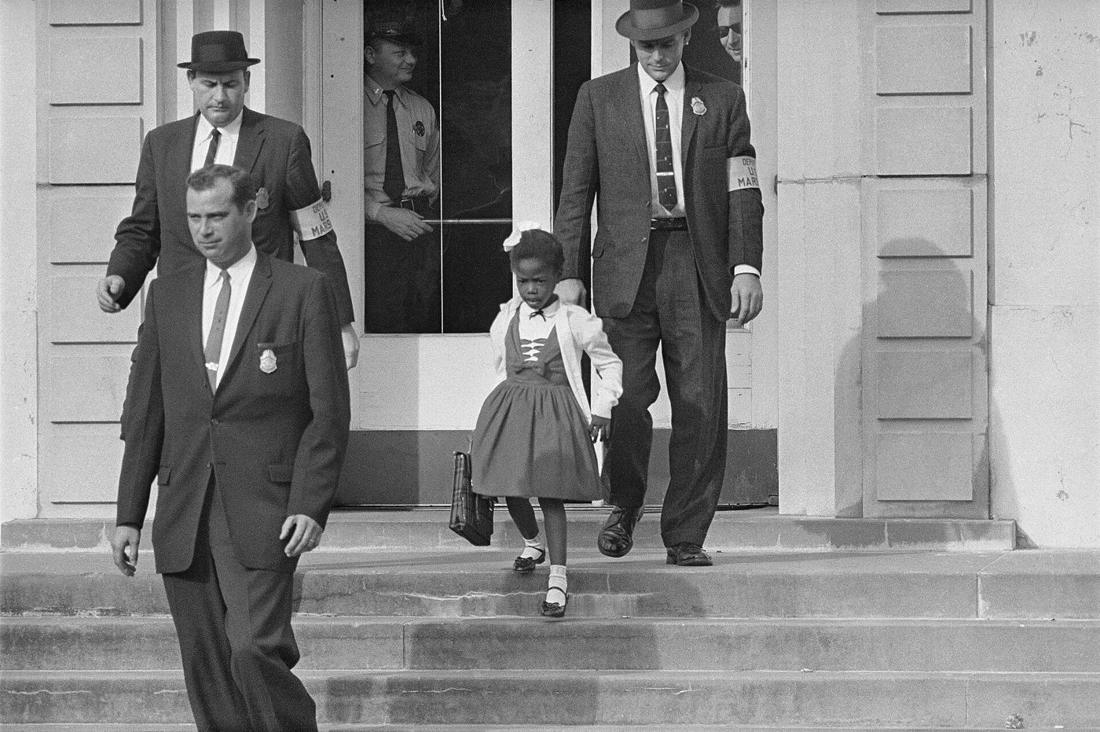
  • On 14 November 1960, Ruby Bridges, aged six, became the first Black child to attend William Frantz Elementary School in New Orleans.
  • Four federal marshals walked her to school because crowds shouted at her. Many white parents took their children out of the school.
  • Her teacher, Barbara Henry, taught her alone for the whole year.

Sources: Ruby Bridges Foundation · National Women’s History Museum: Ruby Bridges · Norman Rockwell Museum: The Problem We All Live With

What you do

  1. Describe the photo: who, where, what is happening, what is missing.
  2. Read the facts and write the day from the point of view of a marshal (a character, in the past tense).
  3. Look at Norman Rockwell’s painting The Problem We All Live With (1964) on the museum website (link) and compare it with the photo.

Sentence starters

  • In 1960, Ruby Bridges…
  • The marshals had to…
  • The painter wanted to show…

Speak up

Read your marshal’s diary entry aloud, in 45 seconds.

Learn how to learn · Explain it to a partner

Explain today’s main idea to a partner in 30 seconds, without notes. If you get stuck, that is the part to review.

3

Brown v. Board of Education, 1954

See how a court can open doors.

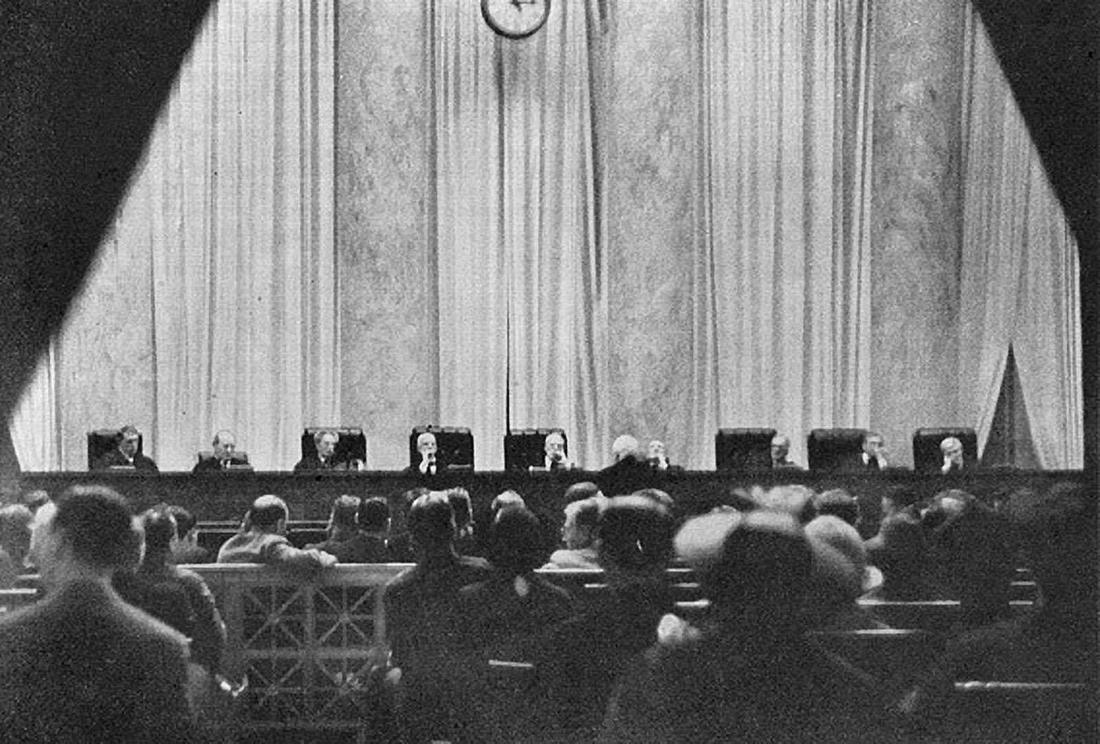
The US Supreme Court in session, 1937.
The US Supreme Court in session, 1937.Image: Unknown author · Public domain · Wikimedia Commons

Documents and facts

  • In 1896, in Plessy v. Ferguson, the Supreme Court accepted “separate but equal” facilities for Black and white Americans.
  • On 17 May 1954, in Brown v. Board of Education, the Court decided: “in the field of public education the doctrine of ‘separate but equal’ has no place. Separate educational facilities are inherently unequal.”

Sources: US National Archives: Brown v. Board of Education · US Courts: Brown v. Board of Education re-enactment

What you do

  1. Read the quote and explain “inherently unequal” in simple words.
  2. Why did Ruby Bridges still need marshals six years after Brown?
  3. Make a two-column chart: what a law can change / what a law cannot change quickly.

Sentence starters

  • The Supreme Court decided that…
  • Separate means unequal because…
  • A law can change…, but not…

Speak up

In pairs, one student is a lawyer in 1954 and explains the decision to a journalist.

Learn how to learn · Word + picture

Draw a tiny picture next to each new word. Your brain remembers a word and an image better than a word alone.

4

The same court can also close doors

Understand that court decisions can move in both directions.

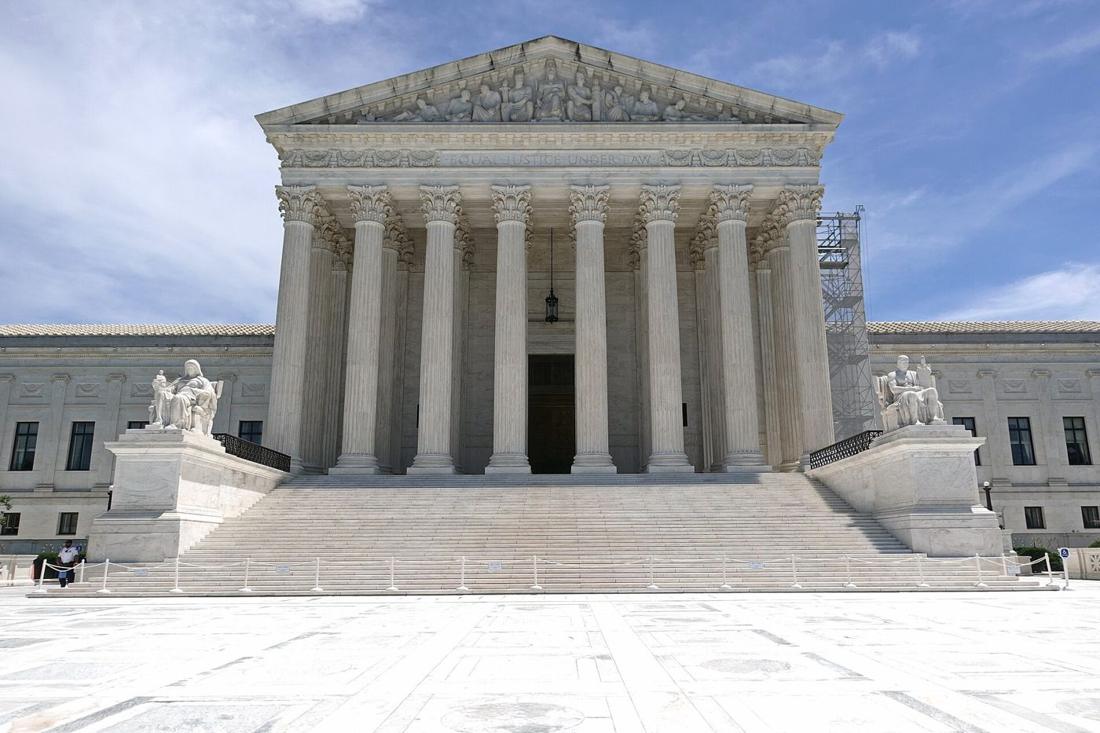
The Supreme Court building in Washington, D.C.
The Supreme Court building in Washington, D.C.Image: 颐园居 · CC BY-SA 4.0 · Wikimedia Commons

Documents and facts

  • On 29 June 2023, in Students for Fair Admissions v. Harvard, the Supreme Court decided that universities could no longer use race as a factor in admissions.
  • Supporters said it was fair to treat every applicant the same way; opponents said it would reduce diversity on campus.

Sources: Supreme Court of the United States: opinions · Oyez: Students for Fair Admissions v. Harvard (2023)

What you do

  1. Read both positions and underline the values each side uses (equality, diversity, merit…).
  2. Discuss: is treating everyone the same always fair?
  3. Prepare one argument for each side.

Sentence starters

  • Supporters believe that…
  • Opponents fear that…
  • Treating everyone the same is / is not always fair because…

Speak up

Quick debate: each speaker gives one fact and one value.

Learn how to learn · Homemade flashcards

Write a question on one side and the answer on the other. Test yourself today, in 2 days and in a week.

5

Create your own game: Supreme Court

Invent a role-play game with judges and lawyers.

What you do

  1. Make case cards (invented school cases), role cards (3 judges, 2 lawyer teams, citizens).
  2. Rule: each lawyer must use one fact and one value. Judges explain their verdict.
  3. Write the rules with the rule starters and test them.

Sentence starters

  • Each player must…
  • The judges decide when…
  • You win when…

Speak up

Play one case in front of the class.

Learn how to learn · Spaced review

Review today’s words tonight for 5 minutes, then again in 3 days. Short and spaced beats long and once.

6

Final task: the mock trial

Argue and write a verdict.

What you do

  1. Case: “Should schools mix students from different neighbourhoods?”
  2. Each student argues once (1 minute) as a lawyer or a witness.
  3. The judges write a 100-word verdict; everyone writes their own verdict at home.

Sentence starters

  • As a lawyer, I argue that…
  • The facts show that…
  • As a judge, I believe…

Speak up

1-minute argument during the trial.

Learn how to learn · What I know / What I don’t know yet

Make two columns. A mistake is information: it tells you exactly what to practise next.

★ Create your own game: Supreme Court

A role-play game: case cards, 3 judges and 2 lawyer teams. Each lawyer must use one fact and one value; the judges explain their verdict in a full sentence.

Rule-writing starters

  • The aim of the game is to…
  • Each player must…
  • If you land on…, you…
  • You win when…
  • You miss a turn if…
  • Before you start, …

Final task

Mock trial (B1–B2): each student argues once (1 minute), then writes a 120-word verdict.

Effort badges

Badges reward effort and progress, never a ranking. Everyone can earn every badge.

Brave SpeakerI dared to speak in English, even with mistakes.
Fair DebaterI gave an argument and listened to the other side.
Game DesignerI invented or improved a game.
Fact CheckerI checked a source or spotted a fake.
Comeback BadgeI did better than last time.

✓ Assessment

How will I be assessed?

Printable grid (PDF with QR code)

DURING I practise AT THE END I show what I know

Two kinds of assessment go with you. The first one helps you improve. The second one checks what you have learnt at the end.

During the sequence: formative assessmentAt the end: summative assessment
It helps you improve.It checks what you have learnt.
You are allowed to make mistakes: a mistake you spot is a mistake you will not make again.You show what you can do, with criteria you already know.
You check your own work with the checklist.The teacher uses the same grid as you.
In this sequence: sessions 1 to 5 (the ranking, the marshal’s diary, the lawyer role-play, the quick debate, the Supreme Court game).In this sequence: your written verdict (100 to 150 words), marked out of 20; your 1-minute argument is practice.

While I practise, I can say

  • “I am not sure yet about…”
  • “Can you check if this fact is right: …?”
  • “I made a mistake with… Now I know that…”
  • “The word I want to remember is… because…”

Reminder: Printable grid (PDF with QR code) · Madame Carole Paoli Pompougnac · © 2026 · CC BY-NC-ND 4.0

⎙ Printable fiche

QR code to this journey

The one-page fiche sums up the journey: the big question, the sessions, the sentence starters, the final task and the badges. It has a QR code back to this page.

Open the printable fiche Assessment grid (PDF)

Image credits

Videos, films, songs and protected texts are not copied here: follow the links to the official sources.

Repères pour le professeur (en français)

Niveau : Première · CECRL visé : B1 → B2

Ancrage programme : Axe « Diversité et inclusion » · objets d’étude : logement et mixité sociale ; la Cour suprême des États-Unis, matrice d’inclusion et d’exclusion

Fil rouge : Fairness, Power, Voice. Les blocs « Bridges » relient ce parcours aux autres parcours de la carte.

Évaluation : formative pendant les séances 1 à 5, sommative avec la tâche finale ; grille de notation et grille de correction dans l’onglet professeur du bloc d’évaluation, et en PDF avec QR code.

À noter : Situations inventées uniquement, aucune question sur la carte scolaire vécue par les élèves. Tableau de Rockwell protégé : lien vers le musée seulement.