Level: B2 core · Going further C1 / C2Terminale (general) · BO n°22, 29 May 2025
Words That Move Crowds?Political Speech from Churchill to Social Media
“Can a 15-second clip change more minds than a one-hour speech?”
VoicePowerTruth
A learning journey by Madame Carole Paoli Pompougnac
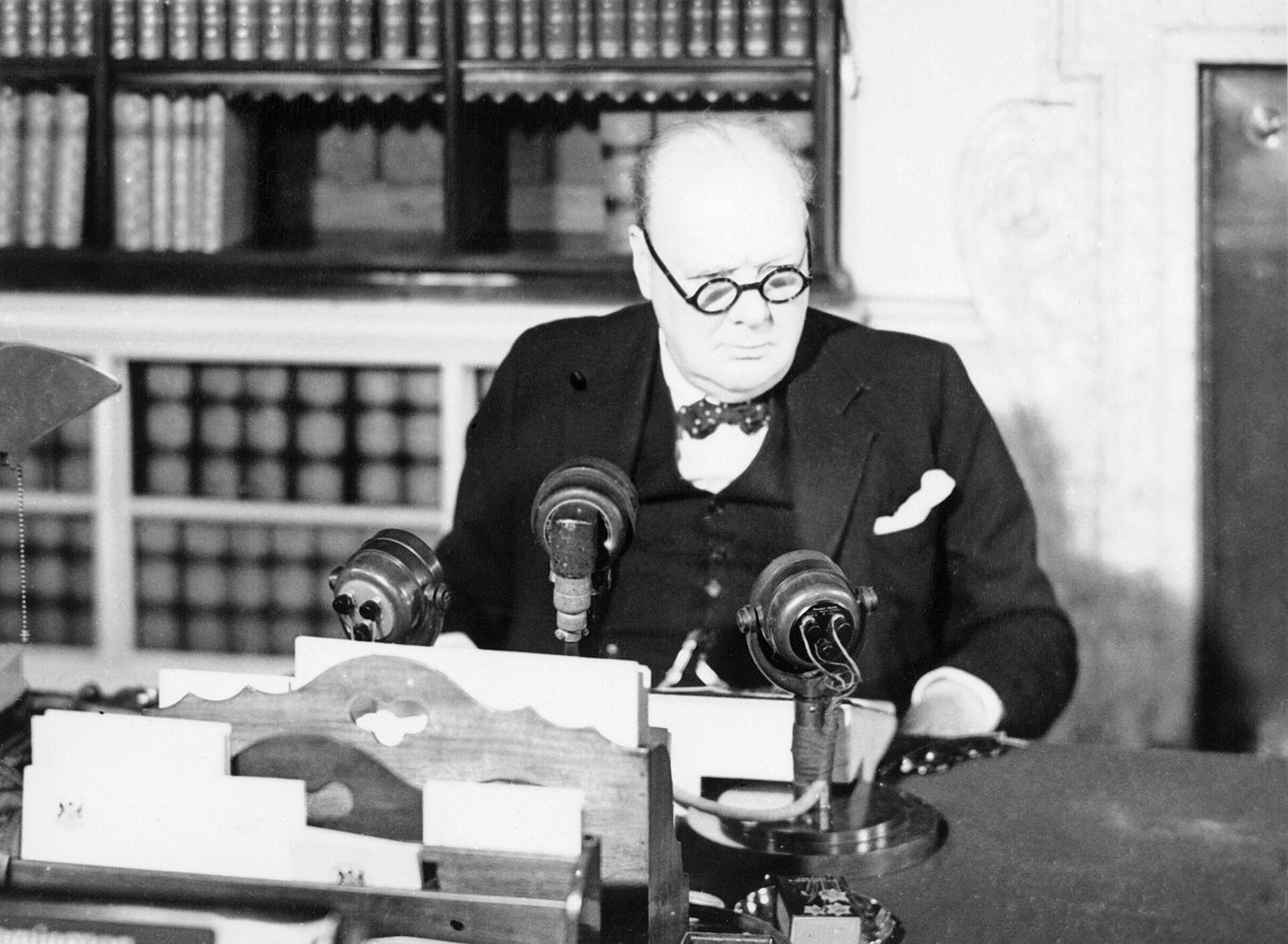
Winston Churchill at a BBC microphone, about to speak to the nation on VE Day, 8 May 1945.Image: War Office official photographer, Egalton (Mr), Horton (Major) · Public domain · Wikimedia Commons
Why this sequence?
Most of you meet political words as short clips and posts: in 2025, 44% of 18 to 24 year olds across 48 markets said that social media and video networks were their main source of news (Reuters Institute).
Knowing how a speech is built helps you see when words try to move you, and when they try to manipulate you.
You will study three speeches in English that changed history, learn the tools of rhetoric and check famous quotes before you share them.
This journey follows Axis 4 of the Terminale programme, “Issues and Forms of Communication” (BO n°22 of 29 May 2025), and prepares the essay at B2, the Terminale LVA level. Each session also has a Going further track at C1 / C2 for advanced and English speaking students.
Our guiding question: from a parliament to a phone screen, how can political words unite people, give a voice to those who are not heard, and sometimes manipulate?
The big question
From a parliament to a phone screen, how can political words unite people, give a voice to those who are not heard, and sometimes manipulate?
ClassTerminale (general)
LevelB2 core · Going further C1 / C2
Sessions6 sessions + a game + a final task
Final taskEssay: “Can a 15-second clip do what a great speech did?” Core: about 300 words (B2). Going further: about 450 words (C1 / C2), with a precise analysis of devices.
Bridges This journey is part of a path: each journey answers and builds on others.
Compare a long speech and a short post, and meet the three tools of persuasion.
Opening ritual
Welcome round: the teacher takes the register while one volunteer presents, in one minute, a famous sentence they know in English and why it stuck in their memory (marked out of 20 with the oral grid: clarity, accuracy, fluency, eye contact).
Social media apps on a smartphone: today, many political words travel as short posts and clips.Image: mikemacmarketing · CC BY 2.0 · Wikimedia Commons
Documents and facts
On 7 November 2017, Twitter raised its limit from 140 to 280 characters for most languages.
In the Reuters Institute Digital News Report 2025, 44% of 18 to 24 year olds across 48 markets said that social media and video networks were their main source of news.
More than 2,300 years ago, the Greek philosopher Aristotle described three ways to persuade: ethos (the speaker is credible), pathos (the audience feels emotion) and logos (the argument is logical).
Look at the photo and read the facts. Guess: how long is the average political clip you see online?
In groups, make two lists: what a long speech can do that a short post cannot, and the reverse.
Sort three short sentences given by your teacher into ethos, pathos and logos.
Sentence starters
A long speech can… whereas a short post…
This sentence appeals to emotion because…
The speaker sounds credible when…
Speak up
Each group presents its two lists in one minute.
C1 / C2Going further · C1 / C2 (advanced and English speaking students)
Authentic document
“Of the modes of persuasion furnished by the spoken word there are three kinds. The first kind depends on the personal character of the speaker; the second on putting the audience into a certain frame of mind; the third on the proof, or apparent proof, provided by the words of the speech itself.” Aristotle, Rhetoric, Book I, chapter 2, translated by W. Rhys Roberts
“On this day, we gather because we have chosen hope over fear, unity of purpose over conflict and discord.” Barack Obama, inaugural address, Washington, 20 January 2009
Match each of Aristotle’s three “kinds” with ethos, pathos and logos. Why does he add “or apparent proof”? What does this tell us about the risk of manipulation?
In Obama’s sentence, find the two antitheses. Which words carry the emotion?
Kairos is the right moment to speak. Obama spoke in January 2009, in the middle of a deep financial crisis. Explain how the moment gives weight to “hope over fear”.
Longer writing
Commentary, about 300 words: “Is a good speech mostly ethos, pathos or logos?” Use both documents and one example from your own experience of social media.
Answer key (Going further)
ethos = the personal character of the speaker; pathos = the frame of mind of the audience; logos = the proof in the words. “Apparent proof” admits that an argument can look logical without being true: this is where persuasion can turn into manipulation.
hope / fear; unity of purpose / conflict and discord. “Hope”, “fear” and “discord” carry the emotion (pathos).
In a crisis, people are afraid: the audience is ready to hear a choice between hope and fear. The same sentence on an ordinary day would sound empty.
Commentary: expected points are the definition of the three appeals, the link between them (credibility makes emotion acceptable, logic makes it last), a nuance on “apparent proof”, and a personal example. Marked with the same grid, criterion 2 requires both documents.
Learn how to learn · Quick Recall
Before you open your notes, write 3 things you remember from last time. Then check. Testing yourself works better than reading again.
Homework
For the next session (date: ____________): Find a short political post or clip (any language, any country). Write 5 lines in English: who speaks, to whom, and which appeal dominates (ethos, pathos or logos). Prepare to present it in one minute.
Answer key
Expected: speaker, audience and medium named; one appeal identified and justified with a word from the post. Example: a minister’s post with a photo of a hospital mainly uses pathos (images of patients) and ethos (her title).
2
Gettysburg, 1863: two minutes
Discover how a very short speech became one of the most famous in English.
Opening ritual
While the teacher takes the register, one student presents their post from last time in one minute (marked out of 20). Then the class checks two homework answers on screen.
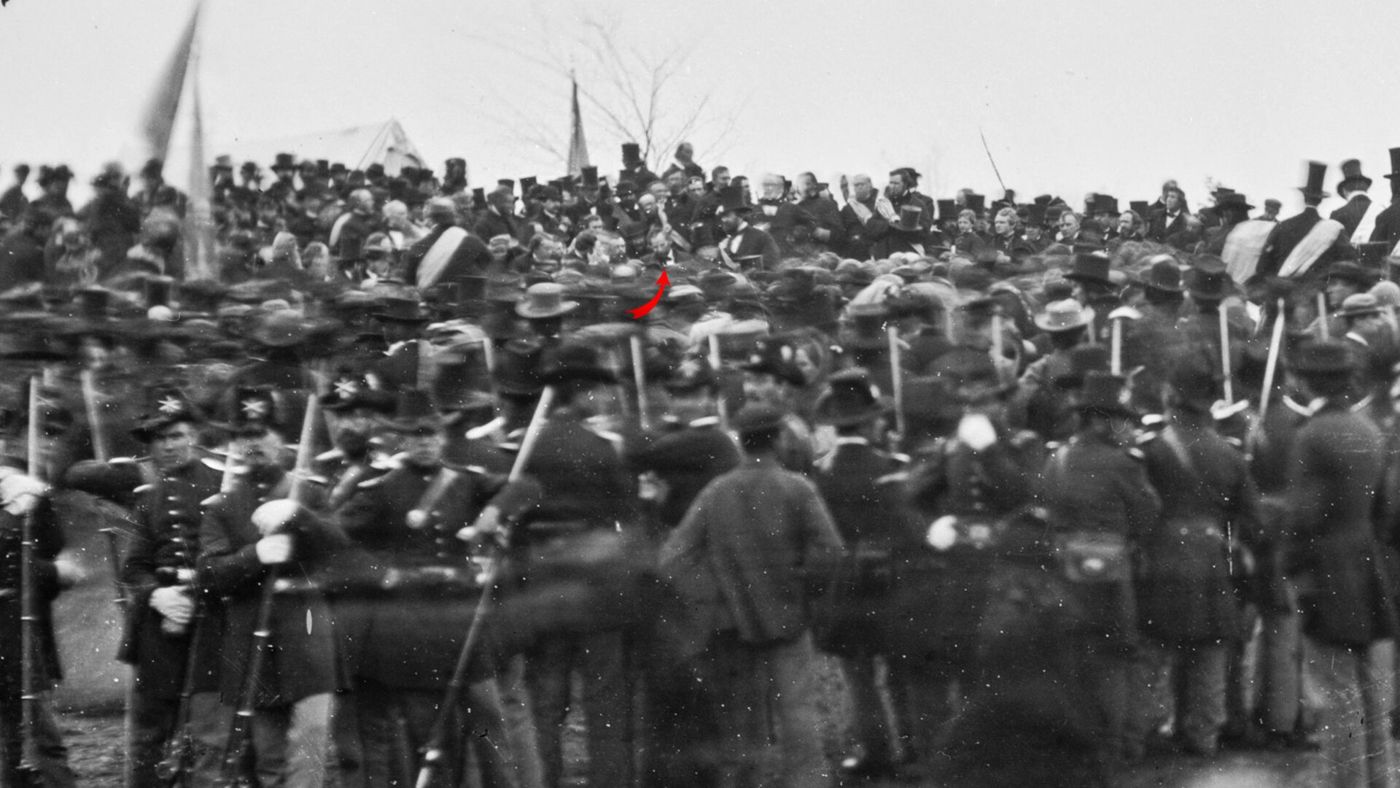
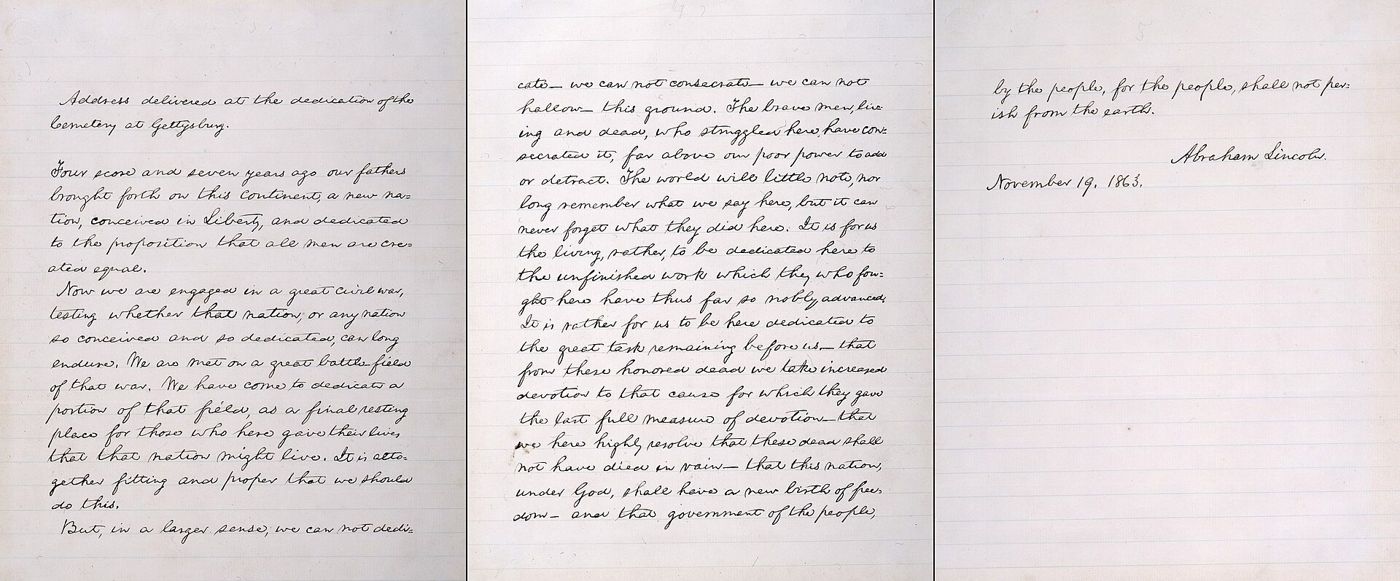
The crowd at Gettysburg, Pennsylvania, on 19 November 1863, the day of the speech. Lincoln is among the people near the speakers’ stand.Image: Mathew Benjamin Brady · Public domain · Wikimedia CommonsThe Bliss copy of the Gettysburg Address, written and signed by Abraham Lincoln.Image: Abraham Lincoln · Public domain · Wikimedia Commons
Documents and facts
On 19 November 1863, during the American Civil War, President Abraham Lincoln spoke at the dedication of the Soldiers’ National Cemetery in Gettysburg, Pennsylvania.
The speech lasted about two minutes. The Bliss copy, written and signed by Lincoln, has about 270 words.
The next day, Edward Everett, the main speaker, who had spoken for about two hours, wrote to Lincoln: “I should be glad, if I could flatter myself that I came as near to the central idea of the occasion, in two hours, as you did in two minutes.”
It ends: “that government of the people, by the people, for the people, shall not perish from the earth.”
Listen to the last sentence read aloud twice. Count the groups of three (a tricolon).
Find in the last sentence what the war is fought for, according to Lincoln.
In pairs, explain why a two-minute speech can be remembered for more than 160 years.
Sentence starters
Lincoln repeats… three times in order to…
The rhythm of the sentence makes the audience…
A short speech can be powerful because…
Speak up
Read the last sentence aloud with the rhythm of a tricolon, then explain its effect in 30 seconds.
C1 / C2Going further · C1 / C2 (advanced and English speaking students)
Authentic document
“Four score and seven years ago our fathers brought forth on this continent, a new nation, conceived in Liberty, and dedicated to the proposition that all men are created equal.”
“The world will little note, nor long remember what we say here, but it can never forget what they did here.” Abraham Lincoln, Gettysburg Address, Bliss copy, 19 November 1863
“Four score and seven years” is 87 years. Which year and which founding text does Lincoln point to? Why choose this solemn, biblical way of counting?
Quote the phrase that echoes the Declaration of Independence. Why is it a strong argument in a war about slavery and the Union?
Analyse the antithesis “what we say here” / “what they did here”. Is it modest, or is it a clever way to give the speech more authority (ethos)?
Longer writing
Commentary, about 350 words, on the two extracts: show how Lincoln turns a funeral ceremony into a statement about the future of the nation. Use at least three devices from the word bank.
Answer key (Going further)
1863 minus 87 gives 1776, the year of the Declaration of Independence. The biblical rhythm (“threescore years and ten”) makes the speech solemn and sacred.
“all men are created equal”: Lincoln presents the war as a test of this founding promise, so the cause of the Union becomes the cause of equality.
Both: the speaker seems humble, which builds trust; yet the speech has been remembered, so the antithesis is also a rhetorical strategy that honours the dead and the speaker.
Commentary: past (fathers, 1776), present (the war, the cemetery), future (“a new birth of freedom”); devices expected: antithesis, tricolon, repetition of “dedicate”.
Learn how to learn · Explain it to a partner
Explain today’s main idea to a partner in 30 seconds, without notes. If you get stuck, that is the part to review.
Homework
For the next session (date: ____________): Learn the last sentence of the Gettysburg Address by heart. Write 5 sentences explaining why a two minute speech can be remembered for over 160 years, with the words tricolon and audience.
Answer key
Model: Lincoln’s speech is short, so it is easy to remember. Its final tricolon, “of the people, by the people, for the people”, has a strong rhythm. The audience at the cemetery wanted meaning, not length. The speech links the war to equality. Today it is still quoted in schools and in politics.
3
Churchill, June 1940: words as weapons
Analyse how a leader can tell the truth about a defeat and still give hope.
Opening ritual
Register: one student recites the last sentence of the Gettysburg Address and explains its tricolon in 30 seconds (marked out of 20). The class corrects the 5 sentences on screen.
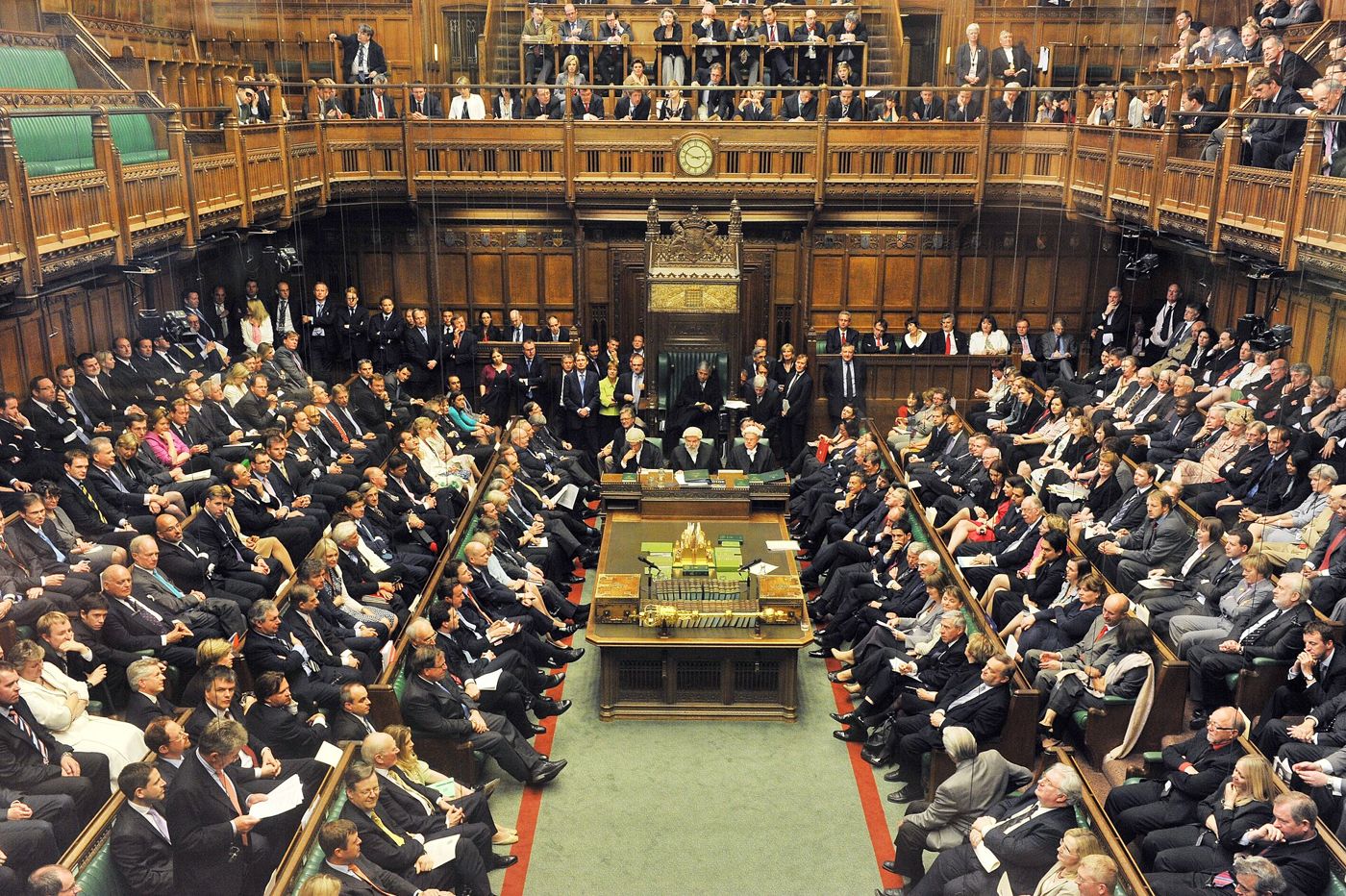
The House of Commons chamber in 2010. The chamber where Churchill spoke in June 1940 was destroyed by bombing in May 1941 and rebuilt in 1950.Image: UK government · OGL 3 · Wikimedia Commons
Documents and facts
On 4 June 1940, after the evacuation of Dunkirk, Prime Minister Winston Churchill made a statement in the House of Commons.
He said that the Navy, “using nearly 1,000 ships of all kinds, carried over 335,000 men, French and British, out of the jaws of death and shame”.
He warned: “We must be very careful not to assign to this deliverance the attributes of a victory. Wars are not won by evacuations.”
Near the end, he said: “we shall fight on the beaches, we shall fight on the landing grounds, we shall fight in the fields and in the streets, we shall fight in the hills; we shall never surrender”.
Count how many times “we shall” appears in the last quote. This repetition at the start of each phrase is called anaphora.
Find the sentence where Churchill admits bad news. Why does honesty make the hope at the end more credible (ethos)?
Read the ending aloud in groups of four: each student says one “we shall” line.
Sentence starters
Churchill admits that…, but he also…
The anaphora “we shall” creates a feeling of…
By telling the truth about the defeat, he…
Speak up
Perform the ending as a group, then one student explains in one minute why it works.
C1 / C2Going further · C1 / C2 (advanced and English speaking students)
Authentic document
“We shall go on to the end. We shall fight in France, we shall fight on the seas and oceans, we shall fight with growing confidence and growing strength in the air, we shall defend our island, whatever the cost may be. We shall fight on the beaches, we shall fight on the landing grounds, we shall fight in the fields and in the streets, we shall fight in the hills; we shall never surrender, and even if, which I do not for a moment believe, this island or a large part of it were subjugated and starving, then our Empire beyond the seas, armed and guarded by the British Fleet, would carry on the struggle, until, in God’s good time, the new world, with all its power and might, steps forth to the rescue and the liberation of the old.” Winston Churchill, House of Commons, 4 June 1940 (Hansard)
Follow the places in the anaphora: France, the seas, the air, the island, the beaches, the hills. What movement does this list create?
Analyse the clause “which I do not for a moment believe”. Why does Churchill imagine defeat and deny it in the same sentence?
In June 1940, the United States was not at war. Who is “the new world”, and who is the hidden audience of this ending (kairos)?
Longer writing
Speech writing, about 400 words: you are a leader who must announce bad news honestly and still give hope (choose a real situation: a factory closing, a flood, a lost final). Use anaphora, a tricolon and one admission of failure.
Answer key (Going further)
From far to near: from France to the beaches of Britain and the hills. The enemy comes closer and closer, but the will to fight stays the same; the rhythm builds tension.
He admits the worst case to sound honest (ethos), then denies it at once: the listener feels the danger and the confidence together.
The United States. Churchill speaks to MPs, but also to the American public and government: he prepares the idea that they will help.
Speech: marked with the grid; full points need a clear admission, three devices used correctly and a hopeful ending that is not a lie.
Learn how to learn · Word + picture
Draw a tiny picture next to each new word. Your brain remembers a word and an image better than a word alone.
Homework
For the next session (date: ____________): Rewrite the “we shall” ending as a 6 line speech for a cause you care about (school life, sport, the environment), with an anaphora and one honest admission.
Answer key
Check: at least three lines start with the same words (anaphora); one sentence admits a difficulty (“We have lost…”, “It will be hard…”); the ending gives hope.
4
Ask not: Kennedy, 1961
Study how a new leader speaks to a whole generation.
Opening ritual
Register: two students perform their “we shall” speech (one minute each, marked out of 20). The class names the anaphora and the admission.
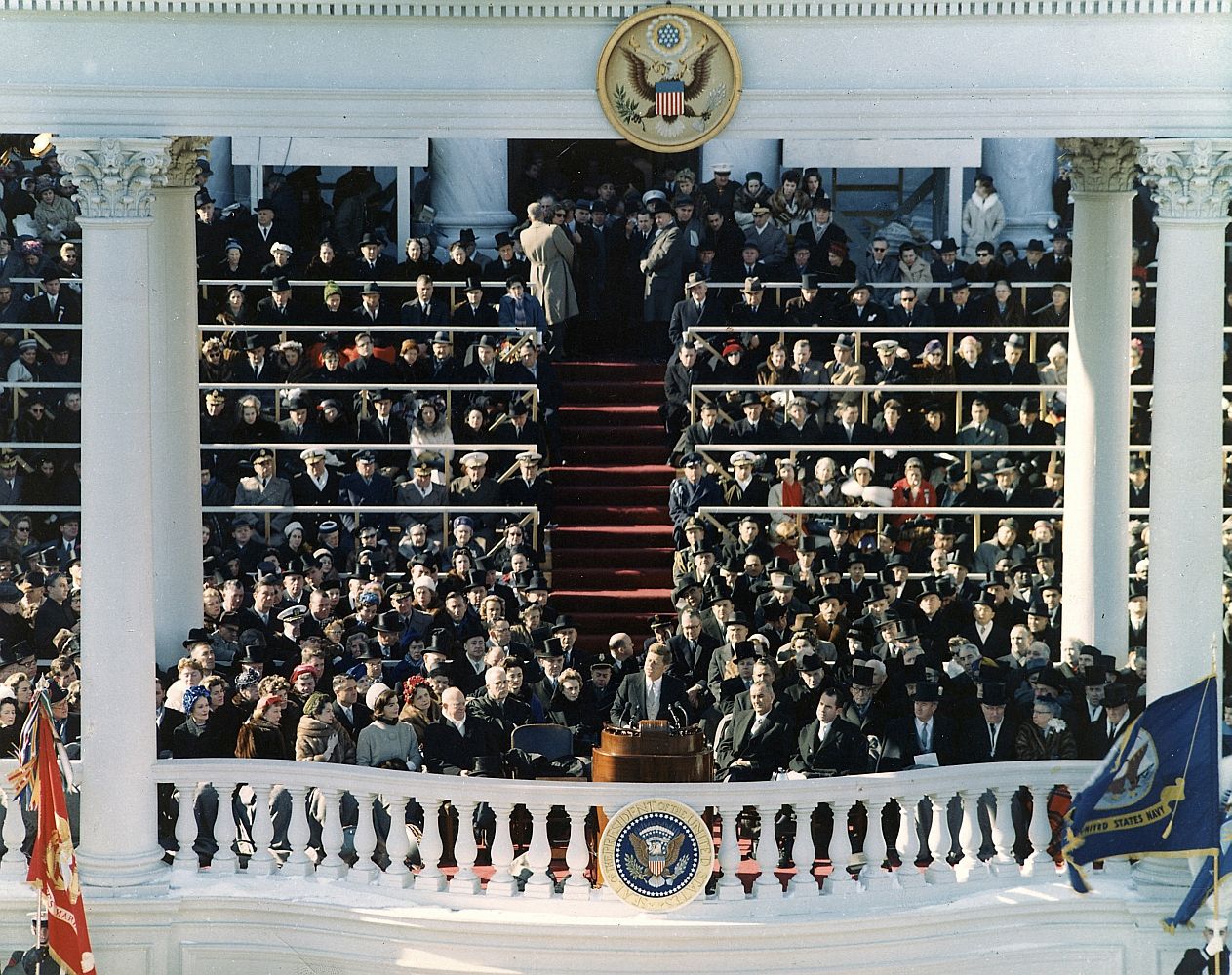
President John F. Kennedy gives his inaugural address at the Capitol, Washington, 20 January 1961.Image: CWO Donald Mingfield, USA · Public domain · Wikimedia Commons
Documents and facts
On 20 January 1961, John F. Kennedy gave his inaugural address as President of the United States in Washington.
His most famous line is built on a reversal: “ask not what your country can do for you” … “ask what you can do for your country.”
This figure of speech, where words come back in the opposite order, is called chiasmus.
Underline the words that come back in the opposite order. Draw the X of the chiasmus.
Discuss: is this sentence a call to unite, or a way to ask citizens to obey?
Write your own chiasmus about a school topic (the canteen, homework, the library).
Sentence starters
Kennedy reverses… in order to…
This sentence speaks directly to…
My own chiasmus is: …
Speak up
Read your chiasmus aloud; the class collects all of them on a Chiasmus Wall.
C1 / C2Going further · C1 / C2 (advanced and English speaking students)
Authentic document
“Let the word go forth from this time and place, to friend and foe alike, that the torch has been passed to a new generation of Americans …”
“Let us never negotiate out of fear. But let us never fear to negotiate.”
“And so, my fellow Americans: ask not what your country can do for you … ask what you can do for your country.” John F. Kennedy, inaugural address, Washington, 20 January 1961
Find a second chiasmus in the extracts. What does it say about the Cold War?
“friend and foe alike”: who are the two audiences of this speech? Why speak to the enemy at an inauguration?
The image of the torch: what does it suggest about Kennedy, the youngest man ever elected President at the time?
Longer writing
Speech writing, about 400 words: the inaugural speech of a newly elected student council president. Include one chiasmus, one antithesis, one tricolon and one image (like the torch).
Answer key (Going further)
“never negotiate out of fear / never fear to negotiate”: be strong, but stay open to talks with the Soviet Union.
Americans and the rest of the world, allies and enemies. The speech is a message of strength and an offer of dialogue at the same time.
A torch is passed in a race: continuity and youth. Kennedy (aged 43) presents his generation, “tempered by war”, as ready to lead.
Speech: four devices correctly used and named in a short margin note; register adapted to a school audience.
Learn how to learn · Homemade flashcards
Write a question on one side and the answer on the other. Test yourself today, in 2 days and in a week.
Homework
For the next session (date: ____________): Exercise: say whether each sentence is a chiasmus, an antithesis or a tricolon. a) “Ask not what your country can do for you … ask what you can do for your country.” b) “we have chosen hope over fear” c) “of the people, by the people, for the people” d) “Let us never negotiate out of fear. But let us never fear to negotiate.”
Answer key
a) chiasmus b) antithesis c) tricolon d) chiasmus
5
Fake quotes travel fast
Learn to check a quote before you share it.
Opening ritual
Register: one student reads their own chiasmus and explains it (marked out of 20). The class corrects the four device exercise on screen.
Documents and facts
“Success is not final, failure is not fatal: it is the courage to continue that counts” is often shared online as a Churchill quote.
The International Churchill Society says it can find this sentence nowhere in Churchill’s writings and speeches.
Quote Investigator found a very close version in a 1938 newspaper advertisement, long before the Churchill attribution spread.
Your teacher shows five quotes on pictures. Before reading the sources, vote: real or fake?
Use the four questions of the Quote Check: Who said it? When? Where is the original document? What is the context?
Check each quote with the sources of this journey (Hansard, Library of Congress, JFK Library, International Churchill Society).
Sentence starters
I think this quote is fake because…
The original document shows that…
Before sharing a quote, you should…
Speak up
Each pair presents one quote and its verdict in 30 seconds.
C1 / C2Going further · C1 / C2 (advanced and English speaking students)
Authentic document
“Hate cannot drive out hate, only love can do that.” Martin Luther King Jr., Strength to Love (1963), as quoted in the viral post
“I mourn the loss of thousands of precious lives, but I will not rejoice in the death of one, not even an enemy.” Not by King: written by Jessica Dovey in a Facebook status, May 2011
In May 2011, Jessica Dovey wrote her own sentence, then a real quote by King in quotation marks. Explain step by step how her sentence ended up “signed” by King.
Why did this fake quote spread so well? Think of kairos and of what people wanted King to have said.
Compare this case with the fake Churchill quote in this session. What do the two cases have in common?
Longer writing
Argumentative essay, about 450 words: “Why do we put words into famous mouths?” Use the two cases and the Quote Check questions.
Answer key (Going further)
The quotation marks were lost when the post was shared, so the whole text looked like King’s; then people kept only the first, shortest sentence.
It appeared just after the death of Osama bin Laden (May 2011), when many people felt uneasy about celebrations: a famous name made the feeling sound wise.
A short, elegant sentence, a prestigious name and no original source: the name gives authority (ethos) that the real author did not have.
Essay: expected nuance, the Dovey case was not a deliberate lie; full points need both cases, a clear thesis and the four Quote Check questions.
Learn how to learn · Spaced review
Review today’s words tonight for 5 minutes, then again in 3 days. Short and spaced beats long and once.
Homework
For the next session (date: ____________): Find one quote shared online and attributed to a famous person. Apply the four Quote Check questions (Who? When? Where is the original? What context?) and write your verdict in 5 lines with the link to your source.
Answer key
Expected: four questions answered, one reliable source (archive, official library, recognised fact checker), a clear verdict: real, false, or real but cut out of context.
6
From the chamber to the feed
Cut a speech into a clip without betraying it.
Opening ritual
Register: one pair presents its Quote Check verdict in one minute (marked out of 20). The class votes before the source is shown.
Documents and facts
A clip keeps only a few seconds of a speech. Cutting can keep the meaning, or change it completely.
Example: “Wars are not won by evacuations” cut alone could sound like a defeatist message. In context, Churchill used it to warn against false celebration before calling for resistance.
Choose one of the three speeches. Choose 15 seconds that keep the speaker’s real message.
Write a caption of 20 words or fewer that does not twist the meaning.
Swap with another group: does their clip respect the original? Use the Quote Check questions.
Sentence starters
We kept this extract because…
If you cut here, the meaning changes because…
Our caption respects the speaker because…
Speak up
Present your clip script and caption; the other group says if the meaning is respected.
C1 / C2Going further · C1 / C2 (advanced and English speaking students)
Authentic document
“To those waiting with bated breath for that favourite media catchphrase, the “U” turn, I have only one thing to say. “You turn if you want to. The lady’s not for turning.”” Margaret Thatcher, speech to the Conservative Party Conference, Brighton, 10 October 1980
Explain the wordplay “U turn” / “You turn”. Why does it work better aloud than in writing?
The second sentence echoes the title of a play, The Lady’s Not for Burning (Christopher Fry, 1948). What does this allusion add?
Which words would a 15 second clip keep? What would it lose about the context (an economic crisis and pressure on her to change policy)?
Longer writing
Commentary, about 450 words, or the final essay at C1 level (see the final task): compare Thatcher’s soundbite with Churchill’s ending. Which one was made for the clip age before it existed?
Answer key (Going further)
A pun on a homophone: the audience hears “you” and “U” together; it mocks her critics and shows confidence.
Cultural complicity with an educated audience and humour, which makes her firmness sound elegant rather than rigid.
The clip keeps “The lady’s not for turning”; it loses who “those waiting” are and the economic debate behind the line.
Commentary: full points need a precise comparison (length, rhythm, humour, kairos) and a nuanced conclusion.
Learn how to learn · What I know / What I don’t know yet
Make two columns. A mistake is information: it tells you exactly what to practise next.
Homework
For the next session (date: ____________): Write the introduction and the plan of the final essay “Can a 15-second clip do what a great speech did?” (about 80 words), using two facts from the journey.
Answer key
Model: Today many young people get their news from short clips. Can a clip do what a great speech did? First, a short form can carry a strong idea, like Lincoln’s tricolon. However, a clip loses the context, as Churchill’s “Wars are not won by evacuations” shows. Plan: 1. what a clip can do 2. what it loses.
Grammar focus: reported speech and reporting verbs
When you analyse a speech, you report it. Do not repeat “he said” every time: choose a precise reporting verb, and use the correct structure after it.
warn (somebody) that / warn somebody not toChurchill warned the House that wars were not won by evacuations.
admit that / admit + -ingHe admitted that the battle had been a disaster. He admitted losing nearly 1,000 guns.
urge somebody to + verbKennedy urged Americans to ask what they could do for their country.
claim thatMany posts claim that Churchill said “Success is not final”.
promise to / promise thatChurchill promised that Britain would never surrender.
Tense shift“We shall fight” becomes: he said that they would fight. “Wars are not won” becomes: wars were not won.
Practise
Report each sentence with the verb given.
“We shall never surrender.” (promise)
“Ask what you can do for your country.” (urge)
“Wars are not won by evacuations.” (warn)
“This quote is by Churchill.” (claim, a social media post)
Answer key
Churchill promised that they would never surrender.
Kennedy urged Americans to ask what they could do for their country.
Churchill warned the House that wars were not won by evacuations.
The post claimed that the quote was by Churchill.
Word bank
Use at least four of these words in your final task.
a speech / an address: a formal talk given to an audience
an audience: the people who listen
rhetoric: the art of persuading with words
anaphora: the same words repeated at the start of several phrases (“we shall…”)
a tricolon: a group of three parallel words or phrases (“of the people, by the people, for the people”)
chiasmus: words that come back in the opposite order (“ask not what your country…”)
a soundbite: a very short extract that is easy to repeat
to misattribute: to say that someone said something they never said
to fact-check: to verify a statement with reliable sources
out of context: without the words around it, so the meaning can change
to rally / to unite: to bring people together for a cause
to manipulate: to influence people in a hidden or dishonest way
propaganda: information used to promote one political view
to go viral: to spread very fast online
eloquent: able to speak in a clear and moving way
Dys support
These adjustments are available to every student who needs them.
Reading comfort mode (button at the top of this page): larger letters, more space between lines and words, no italics.
Every quote is short and has its key words in bold in the fiche; the teacher reads each quote aloud twice.
Colour code for devices: one colour for anaphora, one for tricolon, one for chiasmus.
Essay frame with the sentence starters of each session; students who need it write about 250 words with the essay frame, still at B2. The Going further boxes can be closed to keep the page simple.
Opening ritual: the oral preparation can be a 30 second version, read from a card, with the key words in bold; the student may choose the day.
Homework: the same task in a shorter form (3 lines instead of 5), with a sentence starter given; it can be handed in as an audio note. The Going further boxes are optional.
Oral option for the Quote Check (Session 5) instead of writing.
Extra time for the final essay, and a reading ruler for the documents.
Create your own game: Speech Builder
A card game that you invent. Make Device cards (anaphora, tricolon, chiasmus, rhetorical question, appeal to emotion) and Topic cards on school life (longer lunch breaks, a school garden, more clubs). A player draws one card of each and gives a 20-second speech using the device. The others must name the device. Add Quote Check cards: a player reads a quote and the others ask the four questions before they decide if it is real. Write the rules, test them, and improve them.
Rule-writing starters
The aim of the game is to…
Each player must…
If you land on…, you…
You win when…
You miss a turn if…
Before you start, …
Final task
Essay: “Can a 15-second clip do what a great speech did?” Core: about 300 words (B2). Going further: about 450 words (C1 / C2), with a precise analysis of devices.
Effort badges
Badges reward effort and progress, never a ranking. Everyone can earn every badge.
Brave SpeakerI dared to speak in English, even with mistakes.
Fact CheckerI checked a source or spotted a fake.
Fair DebaterI gave an argument and listened to the other side.
Two kinds of assessment go with you. The first one helps you improve. The second one checks what you have learnt at the end.
During the sequence: formative assessment
At the end: summative assessment
It helps you improve.
It checks what you have learnt.
You are allowed to make mistakes: a mistake you spot is a mistake you will not make again.
You show what you can do, with criteria you already know.
You check your own work with the checklist.
The teacher uses the same grid as you.
In this sequence: sessions 1 to 6 (the two lists, the tricolon reading, the anaphora performance, your own chiasmus, the Quote Check, the clip script).
In this sequence: your essay (core about 300 words, Going further about 450 words), marked out of 20.
While I practise, I can say
“I am not sure yet about…”
“Can you check if this fact is correct: …?”
“I made a mistake with… Now I know that…”
“The word I want to remember is… because…”
The final task. Essay: “Can a 15-second clip do what a great speech did?” Core: about 300 words (B2). Going further: about 450 words (C1 / C2), with a precise analysis of devices.
What I need to do: I tick when it is done
Criteria checked: 0 / 5
Thinking about my work
“I can already…”
“I still find it hard to…”
“The criterion I do best is… because…”
“To improve, I will…”
A ready-to-use grid with the same criteria as the students' checklist. Click one level for each criterion: the total adds up by itself.
1. Task and length / 3
Answers the question, gives a clear opinion, 270 to 330 words (Going further: 420 to 480 words).
2. Arguments with facts / 6
Two parts, each with precise references (Gettysburg 1863, Churchill 4 June 1940, Kennedy 1961, the fake Churchill quote, the 2025 Reuters Institute figure).
3. Nuance / 3
Shows what a clip can do well (reach, speed) and what it can lose (context, nuance), with one example.
4. Organisation / 4
Introduction, connectors (Firstly, However, Finally), conclusion.
5. Language / 4
At least four journey words; correct tenses; errors do not block meaning.
Total: 0 / 20 (5 criteria left to assess)
To mark quickly and fairly: what is expected, what earns full or partial points, and the most common mistakes.
Model answer
Today, 44% of 18 to 24 year olds in 48 markets say that social media and video networks are their main source of news. Political words now reach them as clips of a few seconds. Can such a clip do what a great speech did? On the one hand, a short form can be very powerful. Lincoln’s Gettysburg Address has only about 270 words and lasted about two minutes, yet its last tricolon, “of the people, by the people, for the people”, is still quoted more than 160 years later. Kennedy’s chiasmus, “ask not what your country can do for you”, is short enough to fit in a post. A clip can therefore spread a strong idea very fast. On the other hand, a clip loses the context. On 4 June 1940, Churchill first admitted a disaster: “Wars are not won by evacuations.” Cut alone, this sentence could sound defeatist, but in the full speech it prepares the famous call to resistance, “we shall never surrender”. A clip can also carry words that were never said: the International Churchill Society shows that “Success is not final, failure is not fatal” is not in Churchill’s canon. To conclude, a 15-second clip can carry the rhythm of a great speech, but not its reasoning. It can unite people, but only if we check the source and look at the context before we share it.
Criterion by criterion
Criterion
Full points
Partial points
0 points
1. Task and length (3)
Clear opinion that answers the question; 270 to 330 words (Going further: 420 to 480 words).
Opinion unclear, or length clearly outside the range.
Off topic or far too short.
2. Arguments with facts (6)
Two different arguments, each supported by an accurate fact or quote from the journey (3 points each).
One complete argument, or two arguments with weak or inaccurate facts.
No argument based on the journey.
3. Nuance (3)
Present, clearly introduced and answered.
Mentioned but not developed.
Missing.
4. Organisation (4)
All three elements.
Two of the three elements.
A list of sentences with no links.
5. Language (4)
Four or more journey words used correctly; few errors.
One to three journey words, or frequent errors.
Meaning often unclear.
Common mistakes to watch for
Mixing up dates: Gettysburg 1863, Churchill in the Commons 4 June 1940, Kennedy 20 January 1961.
Saying that Churchill said “Success is not final…”: it is a false attribution.
Quoting a figure without its source (Reuters Institute 2025).
Only one side: the essay must show what a clip can do and what it can lose.
Naming a device without explaining its effect.
Answer key for the sequence exercises
Session 1
7 November 2017: from 140 to 280 characters
44% of 18 to 24 year olds, 48 markets, Reuters Institute 2025
ethos: credibility; pathos: emotion; logos: logic
Session 2
19 November 1863, Soldiers’ National Cemetery, Gettysburg
About two minutes; about 270 words in the Bliss copy; Everett had spoken for about two hours
Tricolon: of the people, by the people, for the people
Session 3
“we shall” appears 5 times in the ending quoted
Admission: “Wars are not won by evacuations.”
Nearly 1,000 ships, over 335,000 men
Session 4
20 January 1961, Washington
Chiasmus: country / you … you / country
Session 5
The “Success is not final” quote is a false attribution
The one-page fiche sums up the journey: the big question, the sessions, the sentence starters, the final task and the badges. It has a QR code back to this page.
Winston Churchill at a BBC microphone about to broadcast to the nation on the afternoon of VE Day, 8 May 1945. H41843.jpg: War Office official photographer, Egalton (Mr), Horton (Major) · Public domain · Wikimedia Commons
Crowd of citizens, soldiers, and etc. with Lincoln at Gettysburg., NARA, 529085 crop.jpg: Mathew Benjamin Brady · Public domain · Wikimedia Commons
Gettysburg Address Bliss copy.jpg: Abraham Lincoln · Public domain · Wikimedia Commons
President Kennedy inaugural address (color).jpg: CWO Donald Mingfield, USA · Public domain · Wikimedia Commons
Social Media App Icons On The Screen of A Smartphone.jpg: mikemacmarketing · CC BY 2.0 · Wikimedia Commons
Videos, films, songs and protected texts are not copied here: follow the links to the official sources.
Teacher notes
Class: Terminale (general) · Level: B2 core, Going further C1 / C2 (BO n°22 of 29 May 2025)
Programme: Terminale, Axis 4 “Issues and Forms of Communication”. Study object: the form and reach of political speech, from Winston Churchill to social media. Official programme: BO n°22 of 29 May 2025, appendix 4.
Threads: Voice, Power, Truth. The Bridges block links this journey to the other journeys of the map.
Assessment: formative during the sessions, summative with the final task. The marking grid and the answer key are in the teacher tab of the assessment block, and in the PDF with a QR code.
Notes: The speeches are quoted from public sources: Hansard (Open Parliament Licence), the Library of Congress and the John F. Kennedy Presidential Library. Audio and video are given as links only. Differentiation: the core targets B2, the official Terminale LVA level (about 300 words). Each session has a Going further box at C1 / C2 for advanced and English speaking students (longer authentic extracts, finer analysis, writing of 300 to 450 words, with an answer key). Extra sources: Aristotle (Internet Classics Archive), the White House archives, the National Archives, The Atlantic and the Margaret Thatcher Foundation.