Level: LVA B1+ / LVB B1Première (general) · BO n°22, 29 May 2025
Two Cities, One Coast?Vancouver and Seattle Through Each Other’s Eyes
“Why would football fans from two countries invent their own trophy?”
IdentityOwnershipPower
A learning journey by Madame Carole Paoli Pompougnac
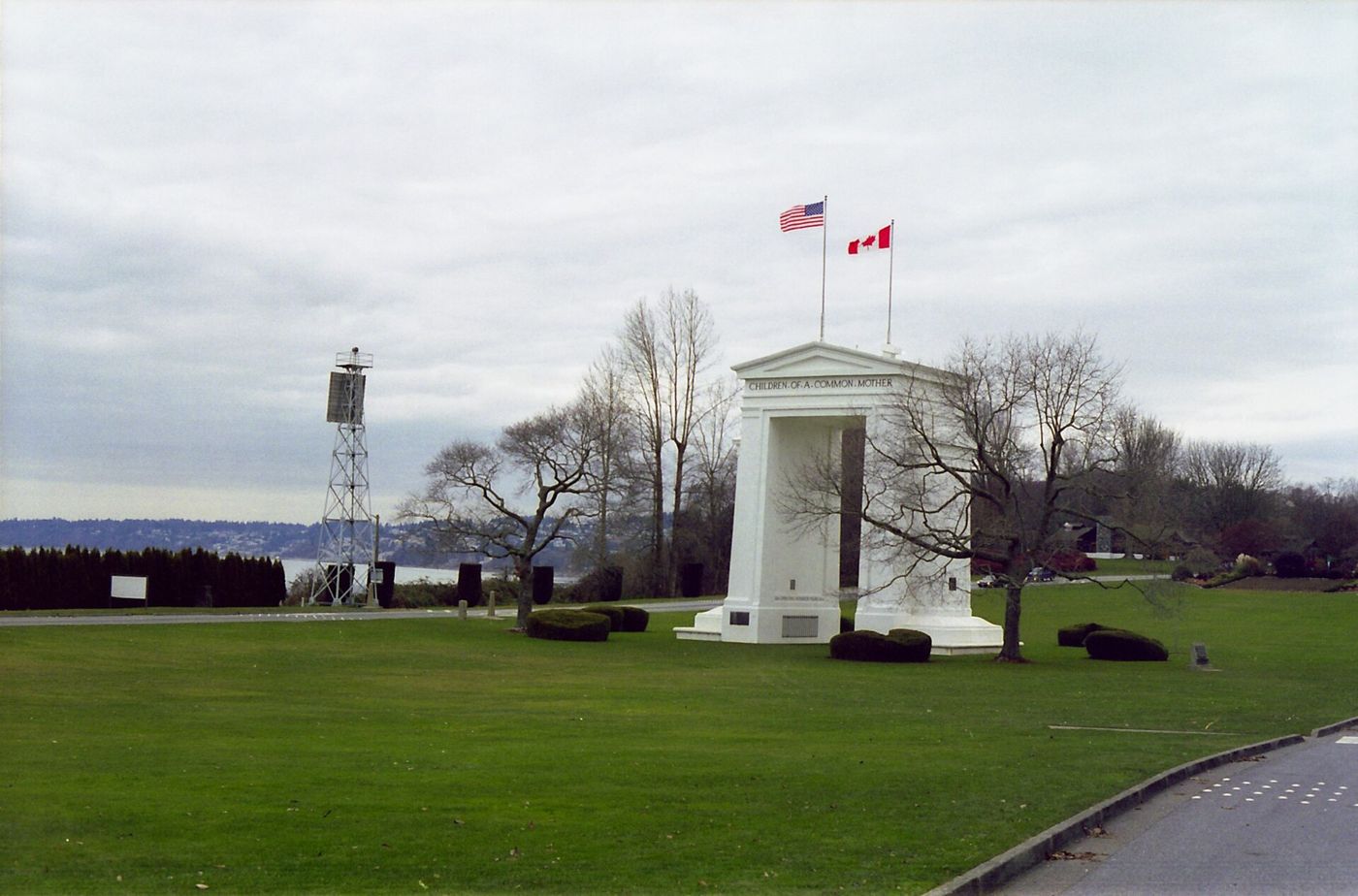
The Peace Arch on the border between Blaine, Washington (United States) and Surrey, British Columbia (Canada).Image: Ken Eckert · CC BY-SA 4.0 · Wikimedia Commons
Why this sequence?
Vancouver and Seattle are two big cities of the Pacific coast, one in Canada and one in the United States, and their stories are tied together like those of neighbours.
Their football fans have competed for the Cascadia Cup since 2004, the Peace Arch has stood on the border since 1921, and gold from the Canadian Klondike made Seattle boom in 1897.
Looking at the two cities side by side, you will learn to compare, to contrast and to check a source, and you will discover the Coast Salish peoples who lived on this coast long before the border.
This journey follows Axis 6 of the Première programme, “The English-speaking Areas of the Americas” (BO n°22 of 29 May 2025), with the study object “Vancouver and Seattle: crossed views”, and it prepares the oral tasks of LVA (B1+) and LVB (B1).
Our guiding question: what do the two cities give each other, and is the exchange equal?
The big question
Vancouver and Seattle share a coast, a history and a border: what do the two cities give each other, and is the exchange equal?
ClassPremière (general)
LevelLVA B1+ / LVB B1
Sessions6 sessions + a game + a final task
Final taskPodcast in pairs (about 3 minutes): “Two cities, one coast?” Compare Vancouver and Seattle and answer the question: is the exchange equal? LVA B1+, LVB B1.
Bridges This journey is part of a path: each journey answers and builds on others.
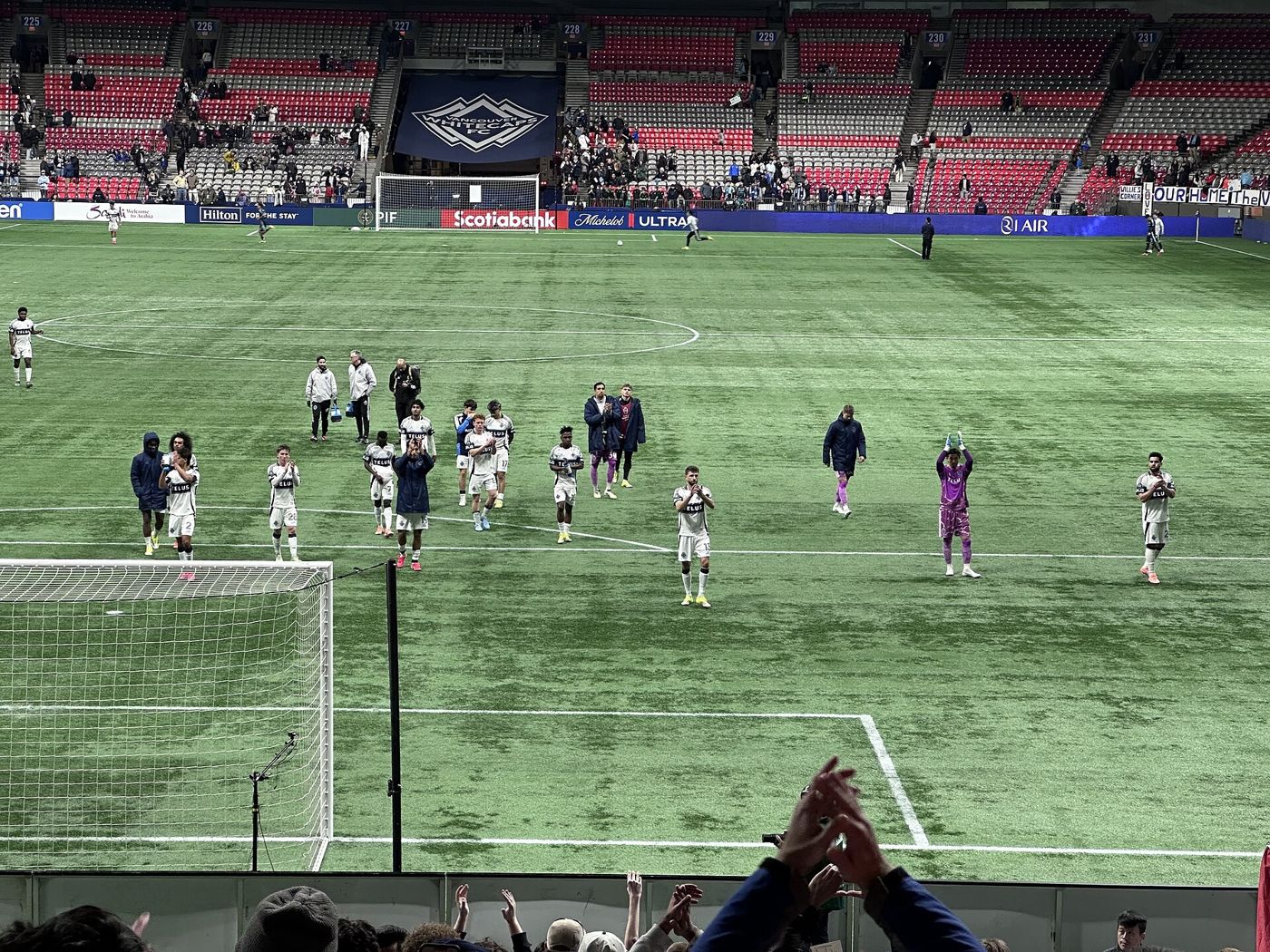
Look at the photo: which two cities are playing? In which country is each city?
Read the facts and find who created the trophy, when and why.
In pairs, list what the fans of the two cities share and what makes them rivals.
Sentence starters
The fans of both cities share…
They are rivals because…
Unlike most trophies, the Cascadia Cup…
Speak up
Each pair presents the rivalry in 30 seconds, as sports reporters.
Learn how to learn · Quick Recall
Before you open your notes, write 3 things you remember from last time. Then check. Testing yourself works better than reading again.
2
Before the border: the Coast Salish world
Learn who lived on this coast before the two cities.
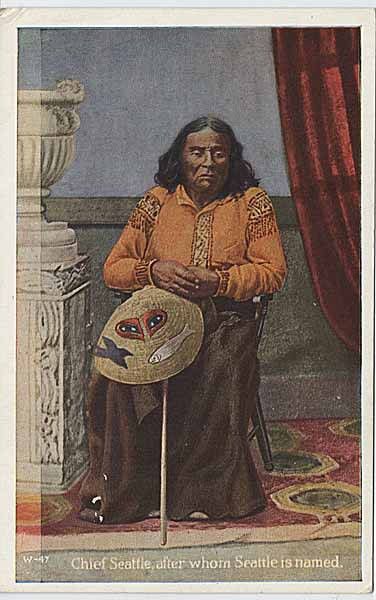
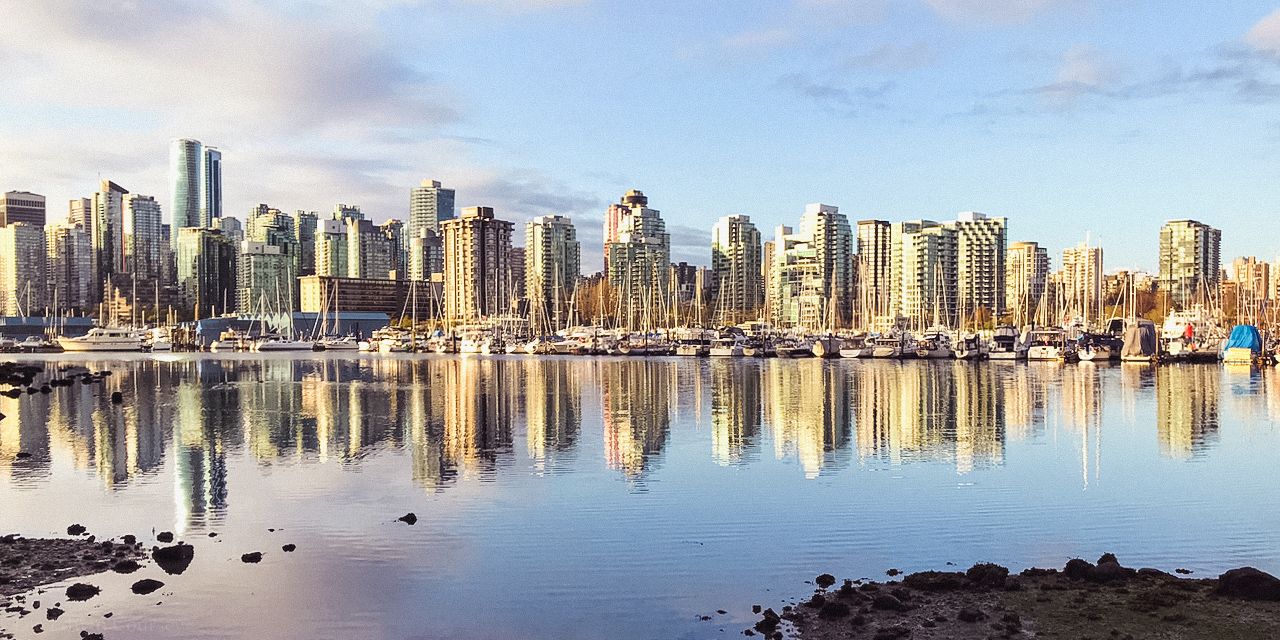
Chief Si’ahl, known as Chief Seattle: a coloured postcard made before 1920 from a photograph taken in 1864.Image: E.M. Sammis · Public domain · Wikimedia CommonsVancouver seen from Stanley Park.Image: Lee Coursey from Decatur, GA · CC BY 2.0 · Wikimedia Commons
Documents and facts
The city of Seattle is named after Si’ahl (Chief Seattle), a leader of the Duwamish and Suquamish peoples, who died in 1866.
Vancouver stands on the unceded traditional territories of the Musqueam, Squamish and Tsleil-Waututh Nations. Unceded means that the land was never given up.
In June 2014, Vancouver City Council formally acknowledged this. The city itself was named after Captain George Vancouver, a British navigator who explored the coast in 1792.
Find the people behind each city’s name: one Indigenous leader, one British navigator.
Explain the word unceded with your own words.
Discuss: what does it say about a city when it is named after someone?
Sentence starters
Seattle is named after…, whereas Vancouver is named after…
Unceded means that…
A name can show who…
Speak up
In one minute, tell the story of the two names.
Learn how to learn · Explain it to a partner
Explain today’s main idea to a partner in 30 seconds, without notes. If you get stuck, that is the part to review.
3
Who wrote Chief Seattle’s speech?
Check a famous text before you quote it.
Documents and facts
Chief Seattle is said to have given a speech in 1854. There is no record from that time.
The first known text was published on 29 October 1887 in the Seattle Sunday Star by Dr. Henry A. Smith, 33 years later, from his notes.
The most famous lines, such as “How can you buy or sell the sky, the warmth of the land?”, were written by the screenwriter Ted Perry for a film called Home, in the early 1970s.
An article of the US National Archives concludes that the speech is “Not proven”.
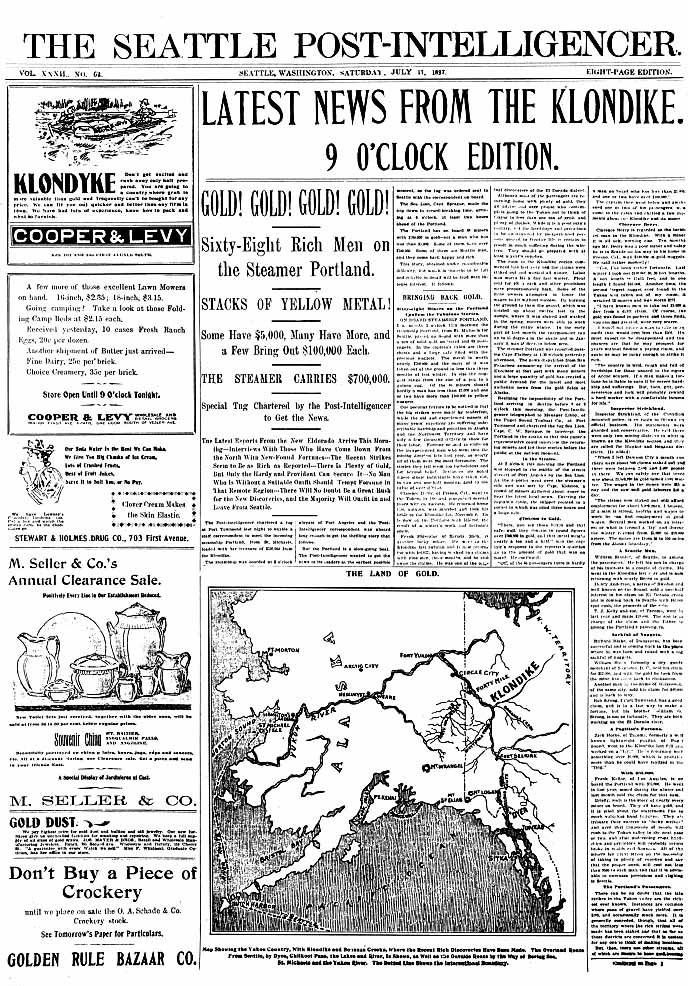
Look at the front page: find the words that create excitement.
Explain why the gold was Canadian but the money was often spent in Seattle.
Write a headline for a Vancouver newspaper of the same day.
Sentence starters
The headline repeats… to create…
The gold came from…, but…
Seattle became rich because…
Speak up
Read your headline as a newspaper seller of 1897.
Learn how to learn · Homemade flashcards
Write a question on one side and the answer on the other. Test yourself today, in 2 days and in a week.
5
Children of a common mother: the Peace Arch
Read a monument as a message.
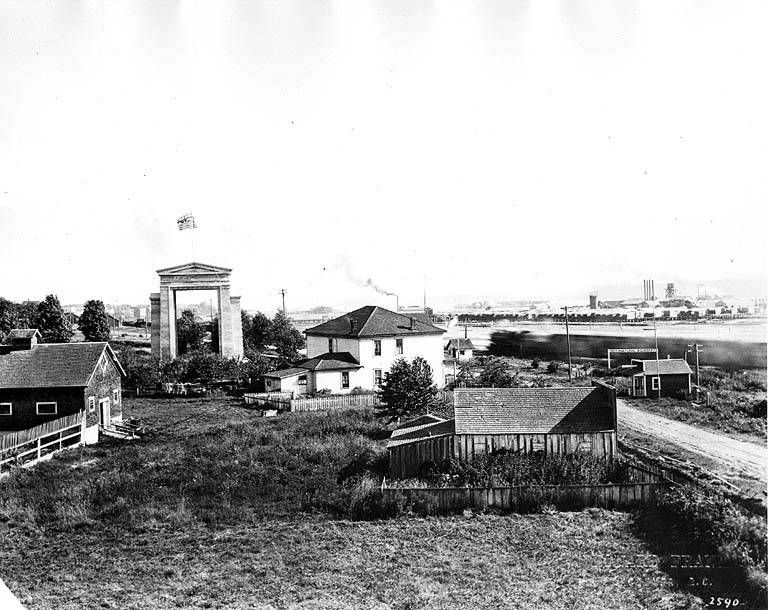
The Peace Arch around 1925, seen from White Rock, British Columbia, looking towards Blaine, Washington.Image: Howard Frank · Public domain · Wikimedia Commons
Documents and facts
The Peace Arch was dedicated on 6 September 1921 on the border between Blaine, Washington, and Surrey, British Columbia.
The United States side reads “Children of a Common Mother”. The Canadian side reads “Brethren Dwelling Together in Unity”.
Inside the arch, iron gates stand open under the words “May These Gates Never Be Closed”.
Compare the two inscriptions: which common mother? Who are the brethren?
Look at the photo of 1925 and the photo of today at the top of this page: what has changed, what has not?
Discuss: is a border a wall, a door, or both?
Sentence starters
The inscription suggests that…
The open gates symbolise…
For me, a border is… because…
Speak up
Give a 45-second guided tour of the Peace Arch.
Learn how to learn · Spaced review
Review today’s words tonight for 5 minutes, then again in 3 days. Short and spaced beats long and once.
6
Towers, floats and screens
Find what the two cities borrow from each other today, and ask if the exchange is equal.
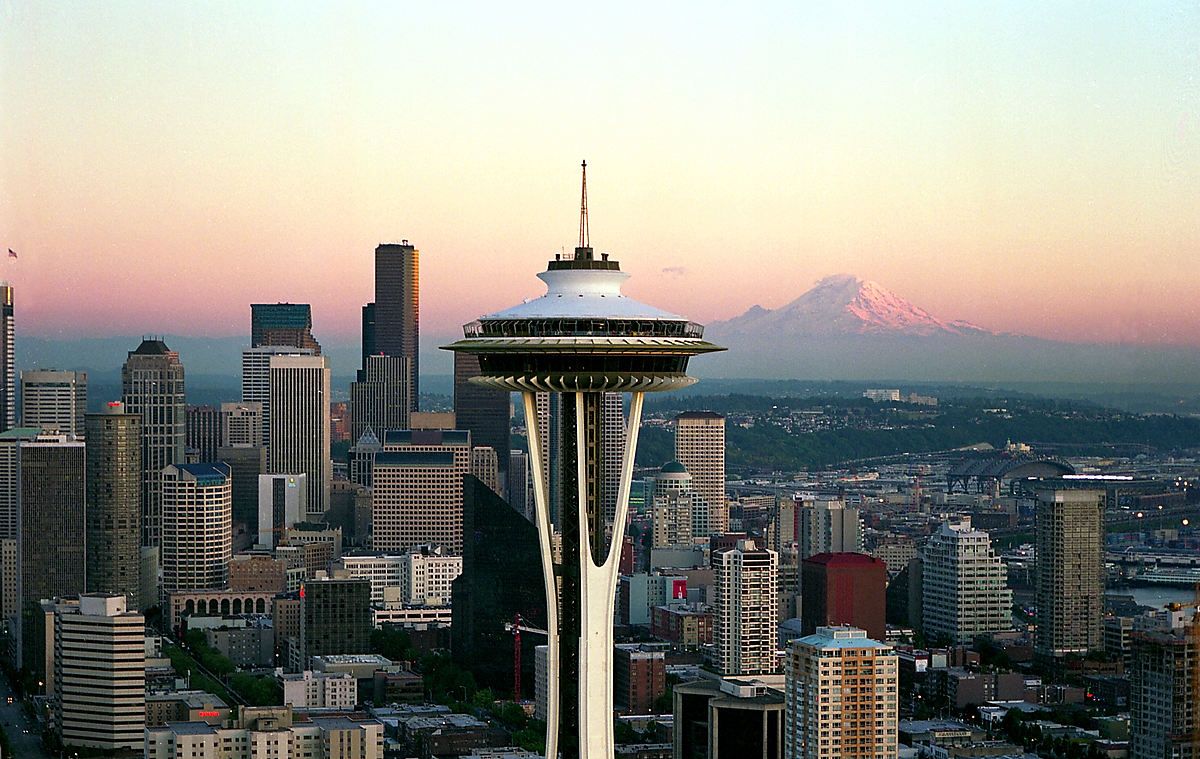
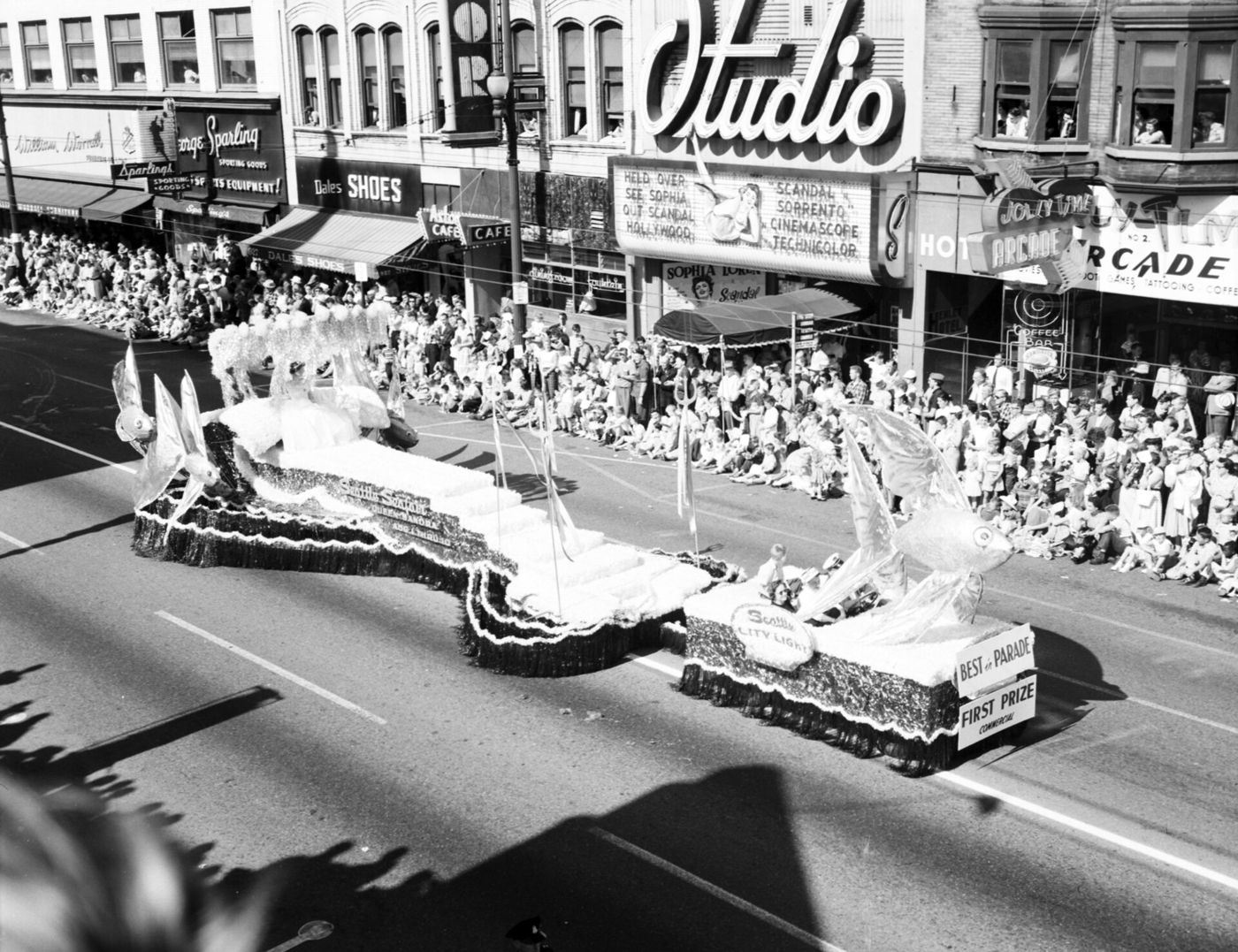
The Space Needle, built for the 1962 World’s Fair, with Mount Rainier behind Seattle.Image: Seattle Municipal Archives from Seattle, WA · CC BY 2.0 · Wikimedia CommonsA Seattle City Light float in the parade of the Pacific National Exhibition, Vancouver, 1956.Image: Seattle Municipal Archives from Seattle, WA · CC BY 2.0 · Wikimedia Commons
Documents and facts
Seattle built the Space Needle for the 1962 World’s Fair. Vancouver hosted the world exposition Expo 86 in 1986.
In 1956, the public electricity company of Seattle sent a float to the Pacific National Exhibition parade in Vancouver.
The television series The X-Files was filmed in Vancouver for its first five seasons, from 1993, and moved to Los Angeles in 1998. Vancouver often stands in for American places on screen.
List what each city gives to the other: visitors, work, images, ideas.
Discuss: when Vancouver plays an American city on screen, who gets the visibility?
Prepare your answer to the big question: is the exchange equal?
Sentence starters
Seattle gives Vancouver…, while Vancouver gives Seattle…
The exchange is not equal because…
On screen, Vancouver is often…
Speak up
Debate in two teams: “The exchange between the two cities is equal.”
Learn how to learn · What I know / What I don’t know yet
Make two columns. A mistake is information: it tells you exactly what to practise next.
Grammar focus: Comparing and contrasting
To look at two cities through each other’s eyes, you need comparison words.
ComparativesThe Peace Arch is older than the Space Needle. Expo 86 is more recent than the 1962 World’s Fair.
as … as / not as … asThe Cascadia Cup is not as old as the Peace Arch.
both … and / neither … norBoth Vancouver and Seattle are on the Pacific coast.
whereas / whileSeattle is in the United States, whereas Vancouver is in Canada.
unlike + nounUnlike Vancouver, Seattle is named after an Indigenous leader.
the same as / different fromThe Cascadia Cup is different from other trophies: the fans bought it.
Practise
Report each sentence with the verb given.
Seattle is in the United States. Vancouver is in Canada. (whereas)
Vancouver is on the Pacific coast. Seattle is on the Pacific coast. (both … and)
Seattle is named after an Indigenous leader. Vancouver is not. (unlike)
The Peace Arch was dedicated in 1921. The Space Needle was built in 1962. (older than)
Answer key
Seattle is in the United States, whereas Vancouver is in Canada.
Both Vancouver and Seattle are on the Pacific coast.
Unlike Vancouver, Seattle is named after an Indigenous leader.
The Peace Arch is older than the Space Needle.
Word bank
Use at least four of these words in your final task.
a coast: the land next to the sea
a border: the line between two countries
to cross: to go from one side to the other
a neighbour: a person or place next to you
a rival: someone you compete against
Indigenous: describing the first peoples of a land
unceded: never given up by its first peoples
a land acknowledgement: a statement that recognises whose land it is
a gold rush: a time when many people go to a place to find gold
a gateway: a place you go through to reach another place
a monument: a structure built to remember something
an inscription: words carved on a monument
a landmark: a famous building that helps you recognise a place
to stand in for: to take the place of (a city on screen)
an exchange: giving and receiving
equal / unequal: the same for both / not the same
Dys support
These adjustments are available to every student who needs them.
Reading comfort mode (button at the top of this page): larger letters, more space between lines and words, no italics.
A timeline with the key dates is given on paper and on the fiche.
Colour code: one colour for Vancouver, one for Seattle, one for what they share.
Podcast frame with the sentence starters of each session; students speak from keywords.
The facts of each session can be read aloud by the teacher or a partner.
Extra preparation time for the podcast, and the option to record it instead of performing live.
Create your own game: Cascadia Crossing
A board game that you invent. The board is the coast between Vancouver and Seattle, with the Peace Arch in the middle. Make Fact cards (1792, 1866, 1897, 1921, 2004, 2014) and Compare cards (“Say one thing the two cities share”, “Say one difference with whereas”). To cross the border, a player must answer a card in English. Add Check cards: a player reads a quote and the others decide if it is real, invented or not proven. Write the rules, test them and improve them.
Rule-writing starters
The aim of the game is to…
Each player must…
If you land on…, you…
You win when…
You miss a turn if…
Before you start, …
Final task
Podcast in pairs (about 3 minutes): “Two cities, one coast?” Compare Vancouver and Seattle and answer the question: is the exchange equal? LVA B1+, LVB B1.
Effort badges
Badges reward effort and progress, never a ranking. Everyone can earn every badge.
Brave SpeakerI dared to speak in English, even with mistakes.
Word HunterI collected new words and used them again.
Fact CheckerI checked a source or spotted a fake.
Story TellerI retold a story or a life in English.
Two kinds of assessment go with you. The first one helps you improve. The second one checks what you have learnt at the end.
During the sequence: formative assessment
At the end: summative assessment
It helps you improve.
It checks what you have learnt.
You are allowed to make mistakes: a mistake you spot is a mistake you will not make again.
You show what you can do, with criteria you already know.
You check your own work with the checklist.
The teacher uses the same grid as you.
In this sequence: sessions 1 to 6 (the sports report, the story of the names, the fact-checker timeline, the 1897 headline, the Peace Arch tour, the debate).
In this sequence: your podcast in pairs (about 3 minutes), marked out of 20.
While I practise, I can say
“I am not sure yet about…”
“Can you check if this fact is correct: …?”
“I made a mistake with… Now I know that…”
“The word I want to remember is… because…”
The final task. Podcast in pairs (about 3 minutes): “Two cities, one coast?” Compare Vancouver and Seattle and answer the question: is the exchange equal? LVA B1+, LVB B1.
What I need to do: I tick when it is done
Criteria checked: 0 / 5
Thinking about my work
“I can already…”
“I still find it hard to…”
“The criterion I do best is… because…”
“To improve, I will…”
A ready-to-use grid with the same criteria as the students' checklist. Click one level for each criterion: the total adds up by itself.
1. Task and message / 4
Answers the question of the final task and gives a clear position.
2. Facts from the journey / 5
Accurate facts with dates (2004, 1866, 2014, 1792, 1887, 1897, 1921, 1962, 1986, 1998) from at least three sessions.
3. Comparison and nuance / 4
Compares the two cities with comparison words (whereas, while, unlike, both) and says if the exchange is equal, with one example.
4. Speaking without reading / 3
Speaks from notes (keywords only), looks at the audience, is easy to hear.
5. Language / 4
Uses sentence starters, connectors and at least four words from the journey; errors do not block meaning.
Total: 0 / 20 (5 criteria left to assess)
To mark quickly and fairly: what is expected, what earns full or partial points, and the most common mistakes.
Model answer
A: Welcome to Two Cities, One Coast. Today we compare Vancouver and Seattle. B: Both cities are on the Pacific coast, but Seattle is in the United States whereas Vancouver is in Canada. A: And they share a long history. Seattle is named after Chief Si’ahl, a Duwamish and Suquamish leader, while Vancouver is named after a British navigator, George Vancouver, who explored the coast in 1792. B: Vancouver stands on unceded Musqueam, Squamish and Tsleil-Waututh land, and the city acknowledged it in 2014. A: Be careful with the famous Chief Seattle speech: the first text was published in 1887, and the most famous lines were written in the 1970s. B: In 1897, gold from the Canadian Klondike made Seattle rich, because the miners bought their equipment there. So the exchange was not equal. A: On screen it is the same: The X-Files was filmed in Vancouver, but the story was set in the United States. B: Yet the Peace Arch of 1921 says “Children of a Common Mother”, and since 2004 the fans have shared the Cascadia Cup. A: So, two cities, one coast? Yes, but the exchange is not always equal. Thanks for listening!
Criterion by criterion
Criterion
Full points
Partial points
0 points
1. Task and message (4)
Clear answer to the question, position stated at the start and at the end.
Position unclear or only at the end.
Off topic or no position.
2. Facts from the journey (5)
At least two accurate facts or quotes from the documents, with names and dates.
One accurate fact, or facts with errors in names or dates.
No fact from the journey.
3. Comparison and nuance (4)
Done fully and clearly.
Done partly, or not linked to the topic.
Missing.
4. Speaking without reading (3)
Notes are keywords only; voice and eye contact help the audience.
Reads for part of the time.
Reads the whole time.
5. Language (4)
Varied starters and connectors, four or more journey words, meaning always clear.
Few connectors or journey words; meaning sometimes unclear.
Meaning often unclear.
Common mistakes to watch for
Saying that Seattle is in Canada or that Vancouver is the capital of Canada (the capital is Ottawa).
Quoting “How can you buy or sell the sky” as Chief Seattle’s real words.
Reading a written text instead of speaking from keywords.
Comparing without comparison words (whereas, while, unlike, both).
Forgetting the question: is the exchange equal?
Answer key for the sequence exercises
Session 1
2004, the supporters of the Sounders, the Timbers and the Whitecaps
The fans paid for the trophy
Session 2
Si’ahl (Chief Seattle), Duwamish and Suquamish, died 1866
Musqueam, Squamish, Tsleil-Waututh; acknowledged in June 2014
Captain George Vancouver, 1792
Session 3
1854: speech said to be given, no record
29 October 1887: Henry A. Smith, Seattle Sunday Star
Early 1970s: Ted Perry, film Home; verdict “Not proven”
Session 4
17 July 1897, steamer Portland
Klondike, Yukon, Canada; Seattle the gateway
Session 5
6 September 1921
Children of a Common Mother / Brethren Dwelling Together in Unity
May These Gates Never Be Closed
Session 6
Space Needle 1962, Expo 86
The X-Files: Vancouver 1993 to 1998, then Los Angeles
The one-page fiche sums up the journey: the big question, the sessions, the sentence starters, the final task and the badges. It has a QR code back to this page.
Vancouver Whitecaps FC players v Seattle Sounders FC 2026-03-12.jpg: IDontHaveSkype · CC BY 4.0 · Wikimedia Commons
Space Needle with skyline and Mount Rainier at sunset, 2000 (3293292089).jpg: Seattle Municipal Archives from Seattle, WA · CC BY 2.0 · Wikimedia Commons
Vancouver Skyline from Stanley Park (41045168080).jpg: Lee Coursey from Decatur, GA · CC BY 2.0 · Wikimedia Commons
Seattle Post Intelligencer newspaper front page for July 17, 1897, announcing the arrival of the steamer PORTLAND in Seattle (SEATTLE 2718).jpg: Unknown author · Public domain · Wikimedia Commons
International Peace Arch, Blaine, Washington, ca 1925 (WASTATE 374).jpg: Howard Frank · Public domain · Wikimedia Commons
Seattle City Light float in Pacific National Exhibition, Vancouver, BC, 1956 (51889816951).jpg: Seattle Municipal Archives from Seattle, WA · CC BY 2.0 · Wikimedia Commons
Videos, films, songs and protected texts are not copied here: follow the links to the official sources.
Teacher notes
Class: Première (general) · Level: LVA B1+ / LVB B1 (BO n°22 of 29 May 2025)
Programme: Première, Axis 6 “The English-speaking Areas of the Americas” (compulsory axis). Study object: Vancouver and Seattle, crossed views. Official programme: BO n°22 of 29 May 2025, appendix 4.
Threads: Identity, Ownership, Power. The Bridges block links this journey to the other journeys of the map.
Assessment: formative during the sessions, summative with the final task. The marking grid and the answer key are in the teacher tab of the assessment block, and in the PDF with a QR code.
Notes: All facts come from public sources linked in each session (City of Vancouver, HistoryLink, US National Archives, National Park Service, Veterans Affairs Canada). The Ted Perry text is quoted only for one line, for analysis. Differentiation: LVA students speak about 90 seconds each with nuance (B1+); LVB students can use the podcast frame and the sentence starters (B1).